
Infrared Thermal Imaging in Home Inspections: What Home Buyers Should Know


When purchasing a home, many important conditions are not immediately obvious during a standard visual inspection. Water intrusion may not yet have produced visible staining. Insulation may be missing behind finished walls. Electrical components may be operating at abnormal temperatures. Air leakage may also be occurring around windows, doors, ceilings, or other areas of the building envelope.
This is where infrared thermal imaging can provide an inspector with another valuable tool.
At One Vision Inspections LLC, thermal imaging may be used during a home inspection to help identify temperature patterns and anomalies that warrant closer investigation. It does not allow an inspector to see through walls, but it can reveal temperature differences that may provide clues about conditions that otherwise might not be readily visible.
What Is Infrared Thermal Imaging?
Everything around us emits infrared energy based partly on its temperature. A thermal imaging camera detects this energy and converts it into an image representing temperature differences across the surfaces being viewed.
Instead of showing the surface exactly as your eyes see it, the camera displays different temperatures using colors or shades.
Depending on the camera settings, warmer areas may appear yellow, orange, red, or white, while cooler areas may appear blue, purple, or black.
The colors themselves do not identify a defect. What matters is the temperature pattern and how it compares with surrounding materials.
Can a Thermal Camera See Through Walls?
No.
This is one of the biggest misconceptions about thermal imaging.
An infrared camera does not see through drywall, ceilings, floors, or other building materials. It measures infrared energy coming from the surfaces visible to the camera.
However, something occurring behind a surface can sometimes affect that surface's temperature.
For example, wet building materials may heat and cool differently than surrounding dry materials. Missing insulation can create a noticeable temperature difference on a wall or ceiling. Air movement can also create cooler or warmer patterns around penetrations and openings.
The camera detects the resulting surface temperature difference—not the hidden condition itself.
What Can Thermal Imaging Help Identify During a Home Inspection?

When conditions are appropriate, thermal imaging can help an inspector identify areas that deserve additional investigation.
Possible Moisture Intrusion
Moisture can sometimes create a different thermal pattern than surrounding dry building materials.
If an unusual temperature pattern is observed near a roof penetration, plumbing fixture, exterior wall, window, basement, or other moisture-prone location, the inspector can investigate further.
Whenever practical, suspicious areas should be compared with surrounding conditions and evaluated using additional methods, such as a moisture meter.
A thermal image alone does not confirm the presence of moisture.
Missing or Inconsistent Insulation
Thermal imaging can sometimes reveal areas where insulation is missing, displaced, compressed, or inconsistent.
During appropriate indoor-to-outdoor temperature differences, these areas may appear noticeably warmer or cooler than adjacent portions of the wall or ceiling.
This can be particularly useful when evaluating finished areas where the insulation itself cannot be directly viewed.
Air Leakage
Temperature patterns around windows, exterior doors, attic accesses, electrical penetrations, and other openings may indicate air movement.
These observations can help identify areas where conditioned indoor air may be escaping or exterior air may be entering the home.
Electrical Temperature Anomalies
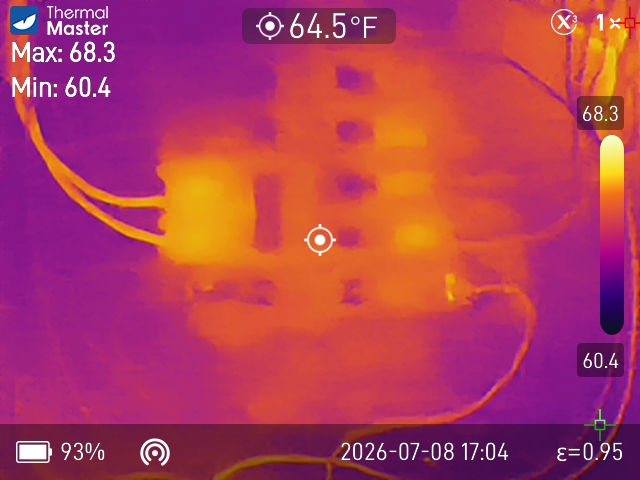
Thermal imaging may also help identify electrical components operating at noticeably different temperatures than surrounding components.
Examples can include breakers, electrical connections, or other accessible components.
An elevated temperature does not automatically mean an electrical component is defective. Electrical loads, environmental conditions, equipment design, and other factors can affect temperature.
Unusual conditions should be evaluated in conjunction with the visual inspection and, when appropriate, referred to a qualified electrician.
Heating and Cooling Systems

Thermal imaging can provide additional information while evaluating HVAC operation.
Temperature differences at supply and return registers can help an inspector determine whether a system appears to be producing heated or cooled air at the time of inspection.
Thermal patterns can also occasionally help identify unusual distribution or airflow conditions.
Radiant Heating Systems
When operating and conditions permit, infrared imaging can sometimes show the heating patterns created by radiant floor or ceiling systems.
This may help identify areas that appear to be heating differently from surrounding portions of the system.
Why Use Thermal Imaging During a Home Inspection?
A home inspection is primarily a visual, non-invasive evaluation of readily accessible components of the property.
Thermal imaging complements that inspection.
Consider two ceilings that look identical to the naked eye. Both may appear clean, dry, and recently painted. A thermal scan could reveal that one portion of a ceiling has a significantly different temperature pattern than the surrounding area.
That does not automatically mean there is a problem.
But it gives the inspector a reason to investigate.
That additional investigation could include looking in the attic, checking the roof above the area, evaluating nearby plumbing, taking moisture readings, or determining whether insulation is missing.
In this way, thermal imaging can help an inspector determine where to look more closely.
Thermal Imaging Is a Tool, Not a Diagnosis
Thermal imaging has limitations, and understanding those limitations is important.
An infrared camera does not directly detect:
Moisture
Mold or biological growth
Termites or other insects
Plumbing leaks
Electrical defects
Missing insulation
Structural damage
Instead, it detects surface temperature differences.
Those differences may be associated with one of these conditions, but additional investigation is necessary before determining the likely cause.
Environmental conditions can also significantly affect thermal imaging.
Sunlight, wind, outdoor temperature, indoor temperature, HVAC operation, reflective surfaces, building materials, and recent weather conditions can all influence what appears on a thermal image.
For that reason, not every hidden problem will produce a detectable thermal signature during an inspection.
Why Experience Matters
Owning a thermal camera and properly interpreting thermal images are two different things.
An inspector must consider the location of the anomaly, building materials, weather conditions, HVAC operation, surrounding temperatures, construction methods, and other observations from the inspection.
A dark blue area on a thermal image isn't automatically a water leak.
A bright red breaker isn't automatically an electrical hazard.
Thermal imaging works best when the information from the camera is combined with the inspector's observations, additional testing tools, and knowledge of building systems.

What Home Buyers Should Expect
Thermal imaging should not be viewed as a replacement for a traditional home inspection.
Instead, it provides another layer of information.
When thermal imaging identifies an unusual condition, the inspector may perform additional investigation when possible and document significant findings in the inspection report.
In some situations, further evaluation by a qualified contractor or specialist may be recommended.
The Bottom Line
Infrared thermal imaging can be a valuable addition to a home inspection because it allows an inspector to evaluate temperature patterns that cannot be identified by sight alone.
It may help direct attention toward possible moisture intrusion, insulation deficiencies, air leakage, electrical temperature anomalies, and HVAC performance concerns.
But thermal imaging isn't X-ray vision, and a thermal camera does not diagnose defects by itself.
The real value comes from combining the technology with a thorough visual inspection, appropriate testing equipment, and professional interpretation.
At One Vision Inspections LLC, thermal imaging is another tool we use to help evaluate the home and provide buyers with more information about the property they are considering purchasing.
See Your Investment Clearly.
Frequently Asked Questions About Thermal Imaging
Does thermal imaging detect water leaks?
Not directly. A thermal camera detects surface temperature differences. Moisture can sometimes create a recognizable temperature pattern, but additional investigation—often including moisture-meter testing—is needed to determine whether moisture may actually be present.
Can infrared cameras see through walls?
No. Thermal cameras measure infrared energy coming from visible surfaces. Conditions behind a wall may sometimes affect the temperature of the wall's surface, allowing an inspector to identify an unusual pattern.
Can thermal imaging find missing insulation?
Sometimes. When there is a sufficient temperature difference between indoors and outdoors, missing or inconsistent insulation may create visible temperature patterns on walls and ceilings.
Does thermal imaging detect mold?
No. Thermal imaging cannot identify mold or biological growth. It may identify temperature patterns associated with moisture conditions that could contribute to biological growth, but further investigation would be necessary.
Is thermal imaging useful during every home inspection?
Its effectiveness depends heavily on conditions at the time of inspection. Indoor and outdoor temperatures, sunlight, weather, HVAC operation, building materials, and other factors can affect the usefulness of thermal imaging.
Is thermal imaging a substitute for a home inspection?
No. Thermal imaging is an additional inspection tool. It works best when used alongside visual observations, moisture meters, electrical testing equipment, and other inspection methods.


Comments